
Overview
Any TSLA stock analysis has to start with a simple observation: Tesla is no longer priced like a car company, and its own numbers make that clear. Tesla sits in the Automobiles industry alongside legacy manufacturers and newer EV entrants, but its market capitalization of roughly $1.44 trillion puts it in a different league entirely. That figure alone tells you the market is pricing in something well beyond current vehicle deliveries and margins — it’s pricing in a story about energy storage, autonomy, and robotics that hasn’t fully shown up in the income statement yet.
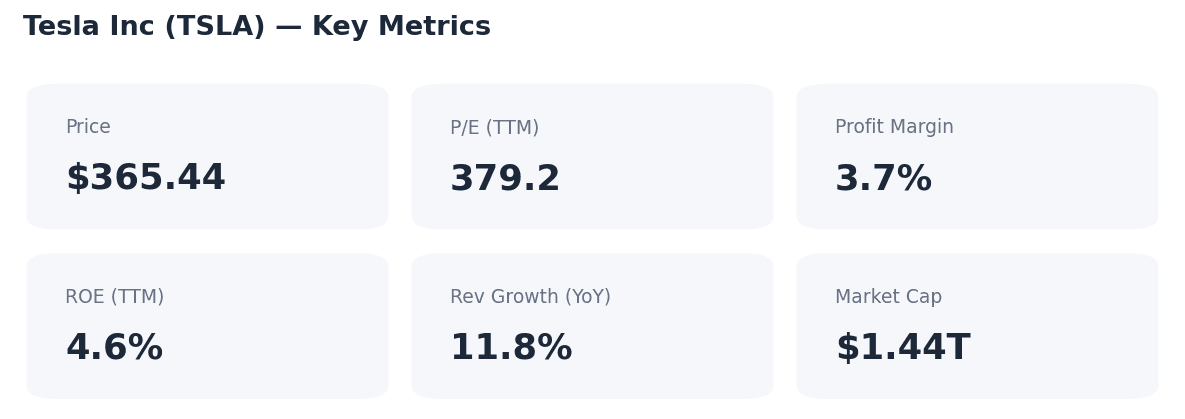
The underlying financials, by contrast, look far more modest than the market cap suggests. Revenue growth of 11.75% year-over-year is respectable but unremarkable for a company still often described as a growth stock. Net profit margin of 3.67% is thin for a business commanding a trillion-dollar-plus valuation, and return on equity of 4.57% is low compared to what investors typically expect from a market leader. None of this means Tesla is struggling — it means the stock’s valuation is doing a lot of work that the current fundamentals alone don’t fully explain.
That gap between narrative and numbers is exactly what makes Tesla one of the more polarizing names for retail investors abroad to analyze. Some see a company still in the early innings of autonomy and robotics; others see a stretched valuation resting on future promises. Both views can be true at once, which is part of why this TSLA stock analysis leans on balance rather than conviction.
Price Action
Tesla shares recently traded at $365.44, up 0.5171% on the day from a previous close of $363.56. That’s a modest daily move, but it’s worth putting into the context of the stock’s wider 52-week range: a high of $498.83 and a low of $297.38. At $365.44, Tesla sits meaningfully below its yearly peak — roughly 27% off the high — while still sitting comfortably above the 52-week low, about 23% higher than that trough.
This positioning, somewhere in the middle third of its annual range, suggests a stock that has cooled from its highs without falling into a full-blown downtrend. For a name as volatile as Tesla, being neither near a 52-week high nor a 52-week low is itself notable — it implies the market is still digesting mixed signals rather than converging on a clear direction. Investors who bought near the low have seen solid gains; those who bought near the high are still underwater.
Day-to-day moves like the 0.5171% gain shown here are small in the context of Tesla’s historical swings, and single-session price action rarely tells you much on its own. What matters more is whether the stock can reclaim ground toward its 52-week high or whether it settles into a lower range while the market waits for clearer evidence on margins, delivery growth, or the newer initiatives generating headlines. Watching how the stock behaves around key news events — rather than any one day’s percentage change — tends to be more informative.
Valuation
This is where the TSLA stock analysis gets sharpest. Tesla’s trailing twelve-month P/E ratio stands at 379.223, based on trailing EPS of just $1.0766. To put that in perspective, a P/E above 300 implies investors are paying an enormous premium relative to current earnings — the kind of multiple usually reserved for early-stage companies with explosive, near-term growth expectations, not an automaker already producing hundreds of thousands of vehicles a year.
Combine that valuation with the thin 3.67% net margin and modest 4.57% ROE, and a pattern emerges: today’s profits don’t come close to justifying today’s price on traditional metrics. That doesn’t automatically make the stock overvalued — it depends entirely on whether future businesses like autonomy, energy storage, or robotics scale up enough to grow earnings dramatically from here. But it does mean anyone evaluating Tesla purely on conventional valuation ratios will find very little comfort in the current numbers.
Tesla also pays no dividend, so there’s no yield cushion to offset the valuation risk — the entire investment case rests on price appreciation tied to future growth, not on income while you wait. That’s a meaningfully different risk profile than income-oriented stocks in the same broad market-cap tier, and it’s worth foreign investors keeping in mind, especially if currency conversion costs and taxes on capital gains versus dividends differ in their home market.
Analyst Consensus
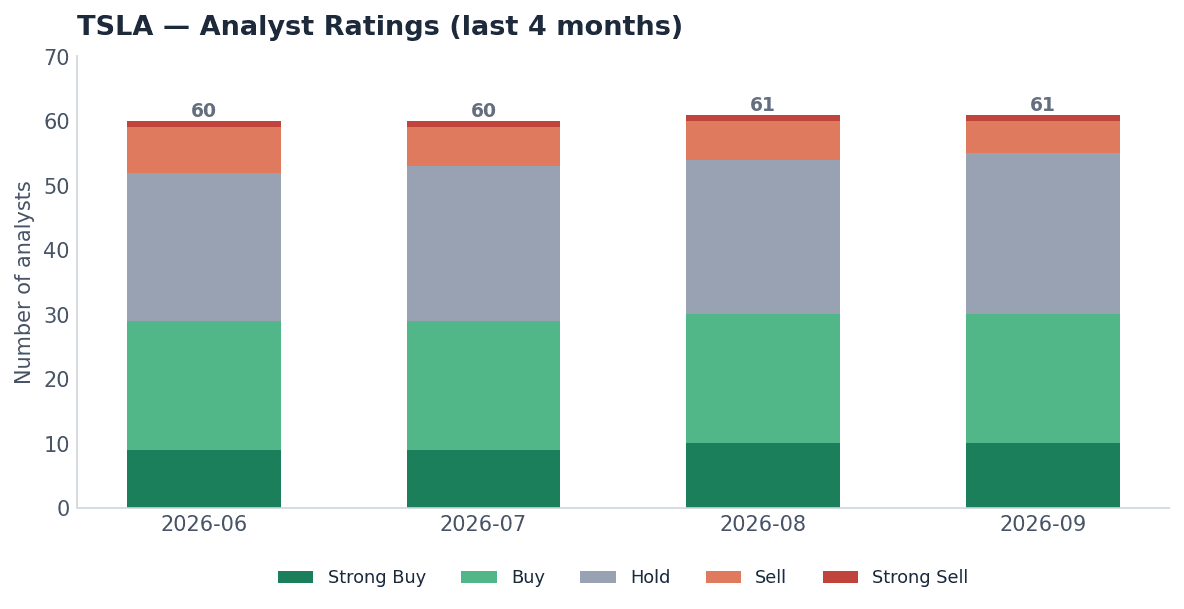
As of the most recent month tracked, 61 analysts had published views on Tesla: 10 rated it strong buy, 20 buy, 25 hold, 5 sell, and 1 strong sell. Adding the bullish camp together — strong buy plus buy — gives 30 analysts, essentially matching the 25 analysts sitting on hold, with only 6 leaning bearish. That’s a meaningful split, not a consensus.
The size of the hold category is arguably the most telling detail here. Twenty-five analysts choosing neither to endorse further upside nor flag downside risk suggests real uncertainty about near-term direction — consistent with a stock whose valuation looks stretched by traditional measures but whose long-term narrative still has believers. It’s not a picture of Wall Street rallying behind one clear thesis; it’s a picture of a genuinely divided analyst community.
For retail investors, this split matters more than any single price target. When ratings cluster this evenly across buy, hold, and a small sell contingent, it’s a signal that reasonable, informed people disagree about what Tesla is worth from here — which means the burden of forming a view falls more heavily on each investor’s own read of the growth story versus the valuation math laid out above.
Recent Catalysts
Several recent headlines help explain why sentiment around Tesla remains so split. One headline reports that Cathie Wood sees an economic boom that Wall Street isn’t pricing in — a view consistent with bullish, growth-oriented takes on companies like Tesla that extend well beyond current-year earnings. Another headline notes a new Tesla Roadster reportedly using SpaceX technology, raising questions about whether it could affect the stock price, though the headline itself doesn’t specify details beyond that framing.
Robotaxi coverage also features prominently. One headline claims a JPMorgan note argues that robotaxi economics flow overwhelmingly to Tesla rather than to a broader “Tesla Network” of participants — a claim that, if accurate, would reinforce the bull case that Tesla captures disproportionate value from autonomy rather than sharing it widely. Separately, a Goldman Sachs-referenced headline points to expectations of 6.5 million humanoid robots by 2035, a data point relevant to Tesla given its robotics ambitions, though the headline doesn’t detail Tesla’s specific share of that projected market.
Not every headline is Tesla-specific. Coverage comparing Rivian and Lucid as EV investments, and a portfolio update tracking Ron Baron’s BAMCO holdings, reflect the broader EV and Tesla-adjacent investing conversation rather than direct Tesla catalysts. Taken together, these reports — all unconfirmed in their full detail beyond the headlines themselves — illustrate why Tesla trades on narrative momentum around autonomy and robotics as much as on its current automotive fundamentals.
Bottom Line
This TSLA stock analysis surfaces a clear tension: a trilling-twelve-month P/E above 379 and modest margins sit awkwardly beside a $1.44 trillion market cap and a genuinely split analyst base. The bull case leans on future robotaxi economics, humanoid robotics, and broader growth narratives referenced in recent headlines. The bear case leans on today’s thin profitability, elevated valuation, and a stock still well off its 52-week high.
Neither side has definitively won the argument, and that’s reflected directly in the 30-25-6 split among strong buy/buy, hold, and sell/strong sell ratings. Investors weighing Tesla will likely need to decide how much weight to put on unproven future businesses versus the valuation math sitting in front of them today.
Disclaimer: This article is for informational purposes only and is not investment advice. Data is sourced from Finnhub and may be delayed. Do your own research before making any investment decisions.
Explore more US stock analysis on Dona Dona.