
Overview
This AAPL stock analysis starts with a simple observation: Apple is once again trading near the top of its 52-week range, and the market seems unbothered by the stock’s already-rich valuation. Shares sit at $336.13, just a few percentage points below the 52-week high of $344.5699, and comfortably above the low of $236.65 set earlier in the period. For a company of Apple’s size — a market capitalization north of $4.9 trillion — this kind of proximity to record territory says something about how investors currently view the durability of its business, even if the day-to-day price action looks unremarkable.
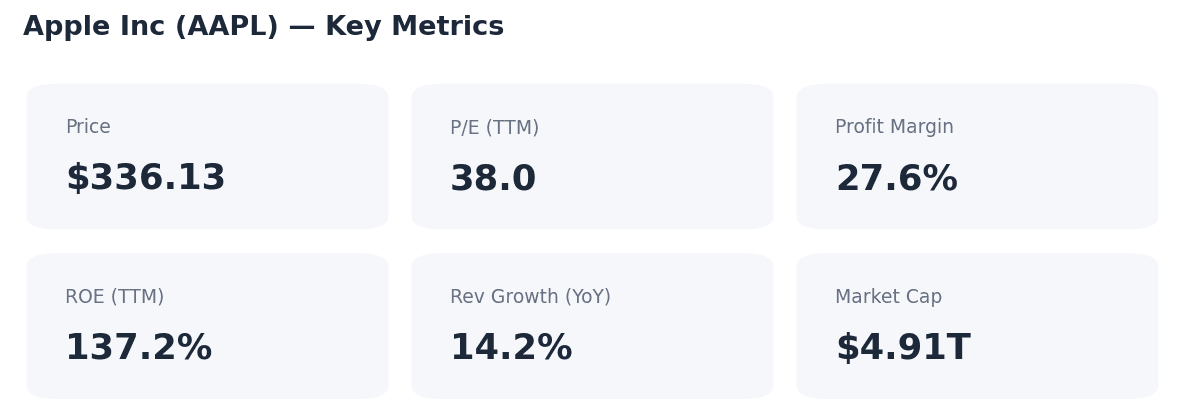
Apple remains classified in the Technology sector, though its business model has long blended hardware (iPhone, Mac, iPad, wearables) with an increasingly important services layer that includes the App Store, subscriptions, and licensing arrangements. That mix matters for how the company’s financial profile behaves. Revenue growth of 14.24% year-over-year is a healthy number for a company this large, and it suggests demand has not stalled out even as the smartphone market broadly matures. The scale Apple operates at means even modest percentage growth translates into enormous absolute dollar figures.
What makes Apple a perennial focus for global retail investors isn’t just its product lineup — it’s the combination of brand loyalty, a vast installed device base, and a financial engine that converts revenue into profit at an unusually high rate. The numbers underlying that engine are explored in the valuation section below, but the top-line takeaway is that Apple continues to be treated by the market as a bellwether for both the technology sector and consumer spending more broadly.
Price Action
Apple’s stock closed the prior session at $337 and now trades at $336.13, a decline of about 0.26% on the day. That’s a minor move in isolation, but it comes against the backdrop of a stock that has already climbed a long way from its 52-week low of $236.65. The gap between that low and the current price is substantial — Apple has appreciated by roughly 42% from its 52-week trough, even after accounting for today’s small pullback.
The stock’s position relative to its 52-week high is arguably more telling than the daily percentage change. At $336.13, Apple is trading only about 2.5% below its all-time high mark of $344.5699 for the trailing year. That’s the kind of chart position technicians describe as “consolidating near highs” — not breaking out aggressively, but not retreating meaningfully either. For a stock this heavily owned by both retail and institutional investors, that kind of steady grind near the top of the range often reflects a market that has largely priced in the known catalysts and is waiting for the next confirmed piece of information, whether that’s an earnings report, a product launch, or new guidance.
It’s worth remembering that daily moves of a quarter of a percent are statistical noise for a stock like Apple. What matters more to long-term holders is the broader trend: a year that took the stock from the mid-$230s to the mid-$330s represents a significant re-rating, and the current price action suggests the market is now digesting that move rather than extending it aggressively in either direction.
Valuation
Here is where this AAPL stock analysis needs to slow down, because the valuation picture is genuinely a two-sided story. Apple trades at a trailing twelve-month P/E ratio of 38.0481, based on TTM earnings per share of $8.7233. That multiple is elevated by historical standards for Apple, which for much of its history traded in the low-to-mid 20s on a P/E basis. A multiple in the high 30s implies that the market is pricing in continued strong execution, not just steady-as-she-goes performance.
Whether that multiple is justified depends heavily on the quality of the underlying business, and by several measures, that quality is exceptional. Apple’s net profit margin (TTM) stands at 27.62%, meaning more than a quarter of every dollar in revenue converts to bottom-line profit — a remarkable figure for a company that still generates the bulk of its revenue from selling physical hardware. Even more striking is the return on equity (TTM) of 137.18%. That figure is unusually high even among mega-cap technology peers, and it partly reflects Apple’s aggressive use of share buybacks and its relatively lean equity base rather than an enormous asset-heavy balance sheet. High ROE numbers like this can flatter comparisons, so it’s worth treating the figure as a signal of capital efficiency and shareholder-return policy rather than a pure apples-to-apples (no pun intended) comparison with less capital-return-focused firms.
The dividend yield of 0.50534% is modest, underscoring that Apple is not primarily an income vehicle — the total return case here still leans heavily on capital appreciation and buybacks rather than dividend income. Put together, the valuation section of any AAPL stock analysis has to acknowledge the tension: a P/E near 38 is not cheap, but it is being paid for a company generating industry-leading margins, exceptional capital efficiency, and double-digit revenue growth. Whether that combination continues to justify the multiple is really the central question for anyone evaluating the stock today.
Analyst Consensus
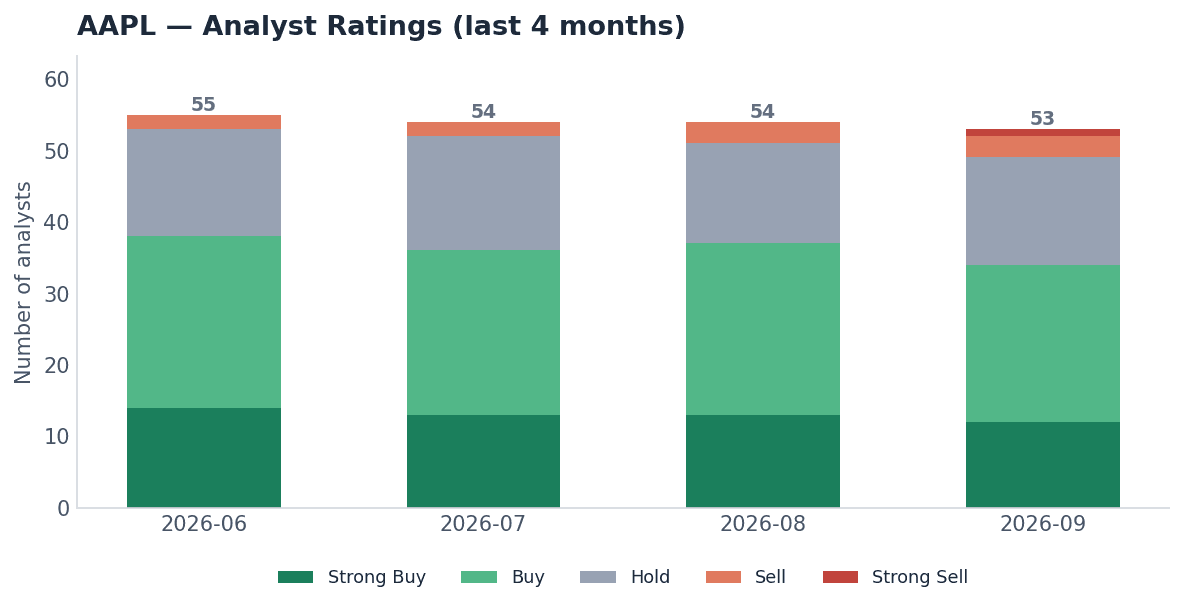
The most recent analyst tally, dated September 1, 2026, shows a distribution that skews positive but is far from unanimous. Of the professional coverage captured, 12 analysts rate the stock strong buy and 22 rate it buy — a combined 34 analysts leaning bullish. That’s set against 15 hold ratings, plus 3 sell and 1 strong sell rating, for a total of 19 analysts expressing either neutral or negative views.
Doing the simple math, bullish ratings (strong buy plus buy) account for roughly 64% of the total coverage in this snapshot, while neutral-to-bearish ratings make up the remaining 36%. That’s a meaningfully positive tilt, but the presence of 15 hold ratings — nearly as many as the strong buy category alone — suggests a real contingent of analysts see the stock as fairly valued at current levels rather than offering a clear margin of safety. The existence of sell and strong sell ratings, while a small minority, indicates the bullish case isn’t universally accepted either.
For a global retail investor trying to interpret this data, the key takeaway is that consensus sentiment leans favorable but is not overwhelming. This isn’t a situation where nearly every analyst on the Street is aligned in one direction — it’s a split that reflects genuine debate about whether Apple’s current price level, and its associated ~38x earnings multiple, adequately reflects both the opportunities and the risks ahead.
Recent Catalysts
Several recent headlines help frame the narrative currently surrounding Apple, though it’s important to treat each as an unconfirmed headline rather than verified fact. One report suggests Apple’s new CEO indicated the company’s AI already has access to users’ personal information — a headline that, if the underlying claims hold up, could feed into ongoing conversations about privacy, data usage, and how Apple’s AI ambitions compare with rivals. Given how central privacy has been to Apple’s brand positioning historically, any developments in this area are worth monitoring closely.
Another headline speculates that Apple’s foldable iPhone lineup, reportedly priced around $1,999, could be a commercial hit, with the prediction going as far as suggesting Apple could join Nvidia in a $5 trillion valuation club. This is explicitly framed as a prediction rather than a confirmed outcome, and given Apple’s current market cap of roughly $4.9 trillion, such a milestone would require further meaningful appreciation from here. Investors should treat this as speculative commentary rather than guidance.
Additional headlines touch on commentary from television personality Jim Cramer sending a “strong signal” to Apple investors, reports that Apple is building its own AI server infrastructure, and a broader piece on India’s big technology companies expanding operations in Hyderabad. There’s also a headline listing Apple among “5 low-risk stocks for the next year” in a retrospective piece marking ten years of coverage. Taken together, these headlines suggest that AI infrastructure, product innovation (particularly foldables), and Apple’s perceived defensive quality are all active themes in the current news cycle — but none of these should be read as confirmed developments without further detail from primary sources.
Bottom Line
This AAPL stock analysis paints a picture of a company executing well on fundamentals — 14.24% revenue growth, a 27.62% net margin, and an extraordinary 137.18% ROE — while trading at a valuation, near 38x trailing earnings, that leaves comparatively little room for disappointment. The stock sits close to its 52-week high, analyst sentiment is positive but divided, and a cluster of headlines around AI capabilities, foldable products, and infrastructure investment suggest the next catalysts are already being anticipated by the market. Whether Apple’s fundamentals continue to justify its premium multiple, or whether the balance shifts toward the more cautious hold and sell views embedded in current analyst coverage, is likely to become clearer as new product and earnings information emerges in the months ahead.
Disclaimer: This article is for informational purposes only and is not investment advice. Data is sourced from Finnhub and may be delayed. Do your own research before making any investment decisions.
Explore more US stock analysis on Dona Dona.