
Overview
Any serious PLTR stock analysis has to start with a simple observation: Palantir Technologies has become one of the most polarizing names in the technology sector, and the numbers explain why. The company trades at a market capitalization of roughly $418.9 billion, an extraordinary figure for a business that, not long ago, was best known as a niche government-data contractor. Today it sits firmly in the technology industry but behaves more like a growth story wrapped in a software wrapper, with revenue growth of 78.92% year over year that few large-cap peers can match.
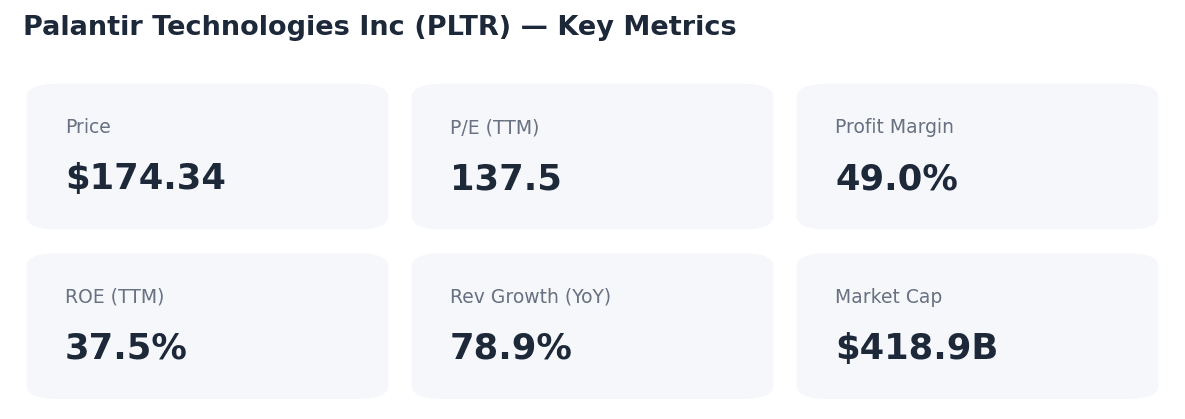
What makes Palantir interesting to a global retail audience is the tension between its operating performance and its price tag. The company is genuinely profitable, with a net profit margin of 49% and a return on equity of 37.47%. Those are not the numbers of a speculative pre-revenue startup. Yet the stock’s valuation multiples suggest investors are pricing in years of continued outsized growth, not just today’s already-strong results. That gap between “excellent business” and “excellent price” is the central question running through this whole piece.
For readers newer to US equities, Palantir is worth understanding as a case study in how the market treats artificial intelligence and data-analytics companies right now. It’s not just about what the company earns today — it’s about the story the market is telling itself about tomorrow. That makes this a name where sentiment, headlines, and narrative can move the stock just as much as the quarterly numbers.
Price Action
Palantir shares recently traded at $174.34, up 1.0315% on the day from a previous close of $172.56. That’s a modest daily move, but it sits within a much wider trading range over the past year. The 52-week high of $207.52 and 52-week low of $106.37 show a stock that has swung by more than 90% from trough to peak within twelve months — a volatility profile typical of high-growth technology names rather than defensive, mature businesses.
At $174.34, the stock is sitting meaningfully below its 52-week high, roughly 16% off that peak, while still trading well above its 52-week low — more than 60% higher, in fact. That positioning matters. It suggests the market has pulled back from peak enthusiasm without fully retreating to prior skepticism. Investors reading price charts alone might interpret this as a stock in a consolidation phase, caught between investors who believe the growth story still has room to run and those who think the earlier highs priced in too much optimism.
For foreign investors unfamiliar with how US growth stocks tend to trade, this kind of wide range is not unusual for a company still proving out its long-term margin structure and market size. What matters going forward is less the single-day move and more whether Palantir can climb back toward its highs — or whether the pullback from $207.52 reflects a more lasting reassessment of what the business is worth.
Valuation
This is where the PLTR stock analysis gets more demanding. Palantir’s trailing twelve-month P/E ratio stands at 137.4591, built on trailing EPS of $1.1735. To put that in plain terms: investors are currently paying more than 137 times the company’s trailing earnings for a single share. That is an extremely rich multiple by almost any historical standard, even within the technology sector, where premium valuations are common for fast-growing names.
There are two ways to read this. The bullish interpretation is that Palantir’s 78.92% revenue growth, paired with a 49% net margin, justifies a premium because the company is scaling profitably rather than growing at the expense of earnings — a combination that is genuinely rare. If growth persists anywhere near current rates, the P/E ratio could compress quickly simply because earnings catch up to the price, without the stock needing to fall at all.
The more cautious interpretation is that a P/E above 137 leaves very little room for disappointment. Any slowdown in revenue growth, any margin compression, or any broader shift in how the market values AI-adjacent software companies could trigger a sharp de-rating. Investors weighing PLTR need to be honest with themselves about how much of the current price already assumes a best-case future. This is not a valuation that rewards patience if growth merely meets expectations rather than beats them — it is priced for continued outperformance.
Analyst Consensus
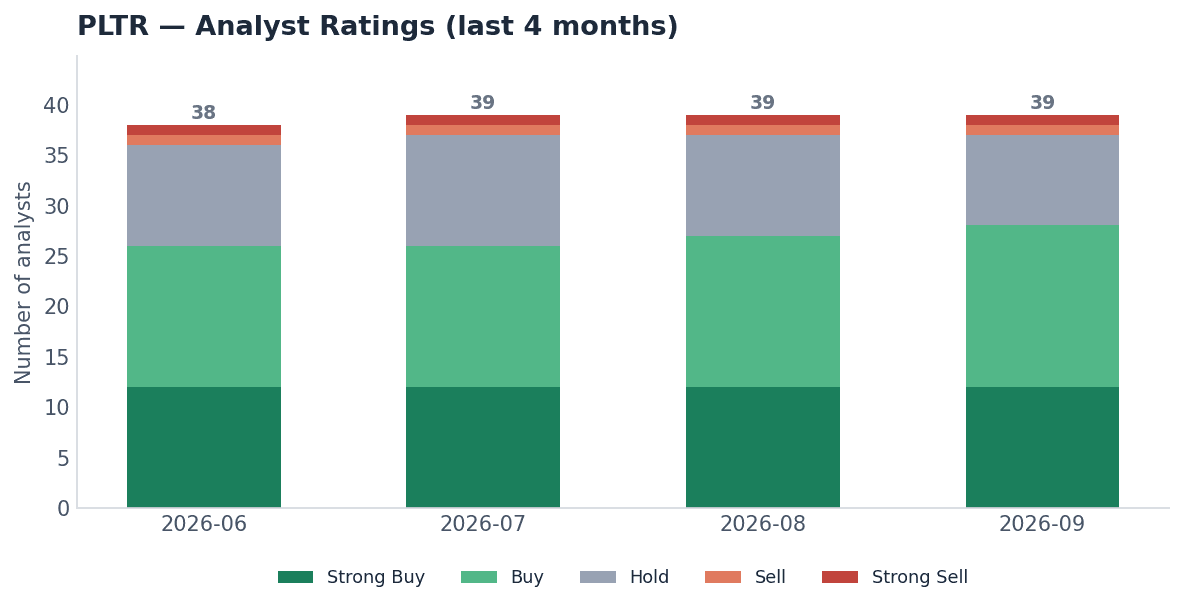
Wall Street’s positioning on Palantir, as of the most recent month of coverage, shows a distribution of 12 strong buy, 16 buy, 9 hold, 1 sell, and 1 strong sell ratings. Adding the bullish camp together — strong buy plus buy — gives 28 out of 39 total ratings, meaning the clear majority of covering analysts hold a positive view on the stock. That skew toward bullishness is notable given how demanding the valuation already looks on paper.
At the same time, the presence of 9 hold ratings is meaningful. That’s nearly a quarter of all analysts choosing neither to endorse further upside nor to caution against the stock outright — often a sign that valuation concerns are weighing against otherwise strong fundamentals. The hold camp effectively represents the “wait and see” contingent: analysts who may respect the business quality but are uneasy pushing clients into a stock trading at such an elevated multiple.
The near-total absence of bearish conviction is also telling — just one sell and one strong sell out of 39 ratings. In practice, that means very few professional analysts are willing to actively bet against Palantir right now, even amid a stock that has pulled back from its 52-week high. Readers should treat consensus ratings as one input among several, not a guarantee, but the current skew does suggest that institutional sentiment remains constructively positioned toward the name for now.
Recent Catalysts
Recent headlines suggest a mixed but active news cycle around Palantir. One headline references “Palantir, Microsoft’s biggest warning gets real for AI stocks,” which points to broader unease about how AI-linked equities are being valued across the sector — a theme that would directly touch a name like Palantir given its AI-software positioning. Another headline, “The $1.5 Trillion Defense Budget That Isn’t Priced In,” hints at a potential government-spending angle that some commentators believe the market hasn’t fully accounted for, though the specifics behind that claim aren’t detailed in the headline itself.
Elsewhere, a headline notes that “UBS resets Palantir stock price target for the rest of 2026,” suggesting at least one major bank has revised its outlook on the stock, though the direction and magnitude of that reset aren’t specified beyond the headline. Separately, one headline states that “Palantir Remains in the Red in 2026” while citing a senior Wall Street analyst calling for “50% Gains to Come” — an illustration of just how wide the range of professional opinion can be on this stock, from caution to outright bullishness, sometimes within the same news cycle.
Finally, a headline titled “Palantir’s Investment Case is Very Simple Now” suggests that at least one commentator views the thesis as having crystallized into a clearer, more straightforward argument, though again, the underlying reasoning isn’t available beyond the title. Taken together, these headlines reflect a stock very much in the middle of an active debate — about AI valuations broadly, about government-related revenue opportunities, and about whether the current price already reflects the best-case scenario. None of these should be read as confirmed developments; they are signals of where market attention and disagreement are currently concentrated.
Bottom Line
Palantir presents a genuinely unusual combination: strong, profitable growth — 78.92% revenue growth and a 49% net margin — married to a valuation that assumes much of that strength continues indefinitely. The stock’s pullback from its 52-week high of $207.52 to a current $174.34 shows a market still working through how much confidence to place in that continuation, even as analyst sentiment remains net-positive with 28 of 39 ratings in the buy camp.
The recent headlines around AI-sector valuation warnings, defense-budget speculation, and diverging analyst price targets underline that this is a stock where narrative and fundamentals are both moving quickly, sometimes in different directions. Investors following this name should weigh the quality of the underlying business against the demands the current P/E of over 137 places on future execution, recognizing that both the bullish and cautious cases have real support in the data available.
Disclaimer: This article is for informational purposes only and is not investment advice. Data is sourced from Finnhub and may be delayed. Do your own research before making any investment decisions.
Explore more US stock analysis on Dona Dona.