
Overview
Visa earnings are back in focus after the payments giant posted its latest quarterly results, and the numbers offer a mixed but informative picture for anyone tracking the stock. Visa Inc (ticker: V) sits in the Financial Services industry and currently trades at $375.28, up 1.3038% on the day. The stock carries a trailing twelve-month P/E of 31.0891, based on trailing EPS of 11.7526, and revenue growth of 14.39% year-over-year gives some sense of the underlying business momentum feeding into these earnings prints.
For foreign retail investors less familiar with US reporting conventions, it helps to remember that “beat” and “miss” refer to how actual reported EPS (earnings per share) compares against what Wall Street analysts had estimated in advance. A beat means the company earned more per share than expected; a miss means it earned less. The percentage attached, called the “surprise,” measures how large that gap was relative to the estimate. These are the only lenses we’ll use here — no guidance, no analyst commentary beyond what’s stated, just the reported figures.
Latest Quarter (beat or miss?)
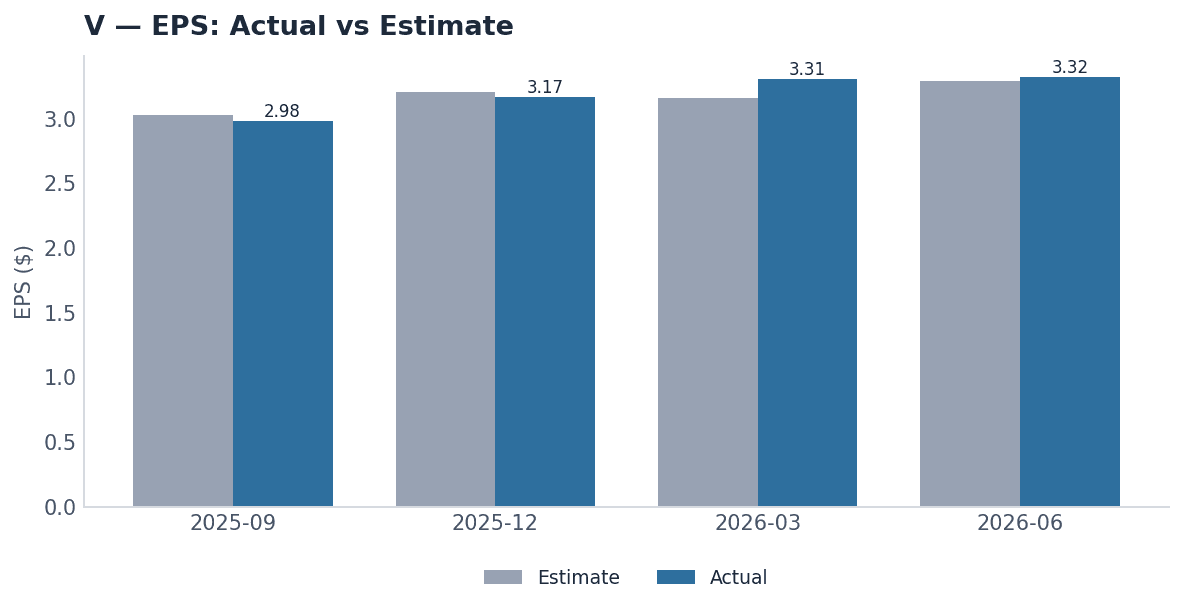
In the most recent quarter shown, for the period ending 2026-06-30, Visa reported actual EPS of 3.32 against an estimate of 3.2923. That is a beat, with a surprise of 0.8414%. In plain terms, Visa earned slightly more per share than analysts had modeled, but the margin was thin — less than one percent above expectations. This is a beat investors would characterize as “in-line to slightly better,” rather than a blowout quarter.
Compare that to the prior quarter, ending 2026-03-31, where Visa posted actual EPS of 3.31 versus an estimate of 3.1579 — a beat of 4.8165%. That earlier surprise was meaningfully larger in percentage terms than the most recent one, even though the absolute EPS figure (3.31) was only a cent below the latest quarter’s 3.32. This matters: the size of the beat, not just the beat itself, tells you something about whether estimates are keeping pace with the company’s actual performance, or whether they’ve been chronically too conservative or too aggressive.
Visa Earnings Trend Across the Quarters
Looking at all four quarters together tells a more complete story than any single print. Going furthest back among the data given, the quarter ending 2025-09-30 showed actual EPS of 2.98 against an estimate of 3.0257 — a miss, with a surprise of -1.5104%. The following quarter, ending 2025-12-31, also missed: actual EPS of 3.17 versus an estimate of 3.2026, a surprise of -1.0179%. So the two oldest quarters in this set were both misses, of similar magnitude, roughly one to one-and-a-half percent below expectations.
Then the pattern flipped. The two most recent quarters — 2026-03-31 and 2026-06-30 — were both beats, first by a wide 4.8165% margin, then by a much narrower 0.8414% margin. Sequentially, EPS itself has been on an upward trajectory: 2.98, then 3.17, then 3.31, then 3.32. That’s four consecutive quarters of rising actual EPS, even while the beat-or-miss outcome swung from negative to positive and the surprise size compressed on the way. A trend like this — misses turning into a large beat, then narrowing to a small beat — often signals that analyst estimates are gradually recalibrating closer to the company’s real run-rate, closing the gap that produced the earlier misses.
What It Means
For investors reading Visa earnings reports from outside the US, the practical takeaway is less about any single quarter and more about the direction of travel. Two straight misses followed by two straight beats, with EPS climbing each period, suggests the business itself has been performing better than the market initially priced in in late 2025. The shrinking surprise percentage in the latest quarter (0.8414% versus 4.8165% the quarter before) could mean estimates have largely caught up to that improved performance — which is a normal and healthy part of an earnings cycle, not necessarily a red flag.
It’s also worth being cautious about reading too much into a single data set. A revenue growth rate of 14.39% year-over-year, paired with rising absolute EPS, is a reasonable backdrop for consistent earnings beats, but it doesn’t guarantee future quarters will follow the same script. One headline referenced in recent coverage raised the question of whether Visa is “worth buying at 24.9X forward P/E” — a separate multiple from the 31.0891 trailing P/E cited above, and a reminder that valuation questions and earnings-trend questions are related but distinct exercises. Other headlines, such as UK banks exploring a new payments venture or PayPal’s push into agentic payments, point to a competitive backdrop worth watching, though none of these are earnings facts about Visa itself and should be treated as context only, not confirmed developments tied to these results.
Bottom Line
Visa’s last four reported quarters moved from two consecutive misses to two consecutive beats, with actual EPS rising in every period from 2.98 up to 3.32. The size of the beat narrowed in the most recent quarter, which could reflect estimates catching up rather than any weakening in the underlying numbers themselves. Taken together, this Visa earnings pattern points to a business executing consistently, even as the gap between what analysts expect and what the company delivers has narrowed over time. As always, this reported track record is only one input — investors weighing the stock’s current $375.28 price and 31.0891 trailing P/E against these trends will want to keep watching how future quarters compare to estimates, not just whether EPS itself keeps climbing.
Disclaimer: This article is for informational purposes only and is not investment advice. Data is sourced from Finnhub and may be delayed. Do your own research before making any investment decisions.
Explore more US stock analysis on Dona Dona.